



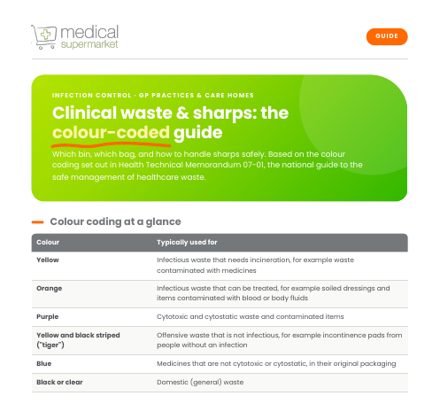
Clinical waste & sharps: the colour-coded guide
Which bin, which bag, and how to handle sharps safely. Based on the colour coding set out in Health Technical Memorandum 07-01, the national guide to the safe management of healthcare waste.
Download the free clinical waste and sharps guide
A printable PDF for GP practices & care homes. Print as many copies as you need.
Everything on the guide
Colour coding at a glance
| Colour | Typically used for |
|---|---|
| Yellow | Infectious waste that needs incineration, for example waste contaminated with medicines |
| Orange | Infectious waste that can be treated, for example soiled dressings and items contaminated with blood or body fluids |
| Purple | Cytotoxic and cytostatic waste and contaminated items |
| Yellow and black striped ("tiger") | Offensive waste that is not infectious, for example incontinence pads from people without an infection |
| Blue | Medicines that are not cytotoxic or cytostatic, in their original packaging |
| Black or clear | Domestic (general) waste |
| Sharps bins: yellow lid | Sharps contaminated with medicines (other than cytotoxic) |
| Sharps bins: orange lid | Sharps not contaminated with medicines |
| Sharps bins: purple lid | Sharps contaminated with cytotoxic or cytostatic medicines |
Safe sharps handling
- Assemble sharps bins correctly and complete the label when you start using them
- Take the sharps bin to the point of use, so you never walk with a used sharp
- Never re-sheathe needles; dispose of the needle and syringe as one unit
- Never fill above the fill line. Close and lock the bin when it is three-quarters full
- Use the temporary closure between uses
- Store bins off the floor, out of reach of children and the public
- Lock full bins and keep them in a secure area until collection
If someone has a sharps injury
- Encourage it to bleed. Gently encourage bleeding; do not suck the wound.
- Wash it. Wash with soap and running water. Do not scrub.
- Cover it. Dry and cover with a waterproof dressing.
- Report it straight away. Tell your manager and seek urgent advice from occupational health or the nearest emergency department, in line with your policy.
- Record it. Complete an incident report.
Waste checklist
- Every room has the right bins for the waste produced there
- Bags are no more than three-quarters full and tied with a swan neck or tag
- Waste is stored securely until collection
- Waste transfer and consignment notes are kept as required
- Staff are trained in segregation
Common questions
Is the clinical waste and sharps guide free?
Yes. It’s one of more than 20 free resources in our GP resources library . Just enter your email to unlock the library and download the PDF.
Can I print it?
Yes. Each resource is a printable A4 PDF, and you can print as many copies as your team needs.
Who is it for?
It’s designed for GP practices & care homes, and is useful for practice managers, nurses and anyone responsible for infection control in your team.
You might also like
Everything on the list, in one order
Order by 4pm for next-day delivery. Call 020 3301 6500 or email help@medical-supermarket.com .